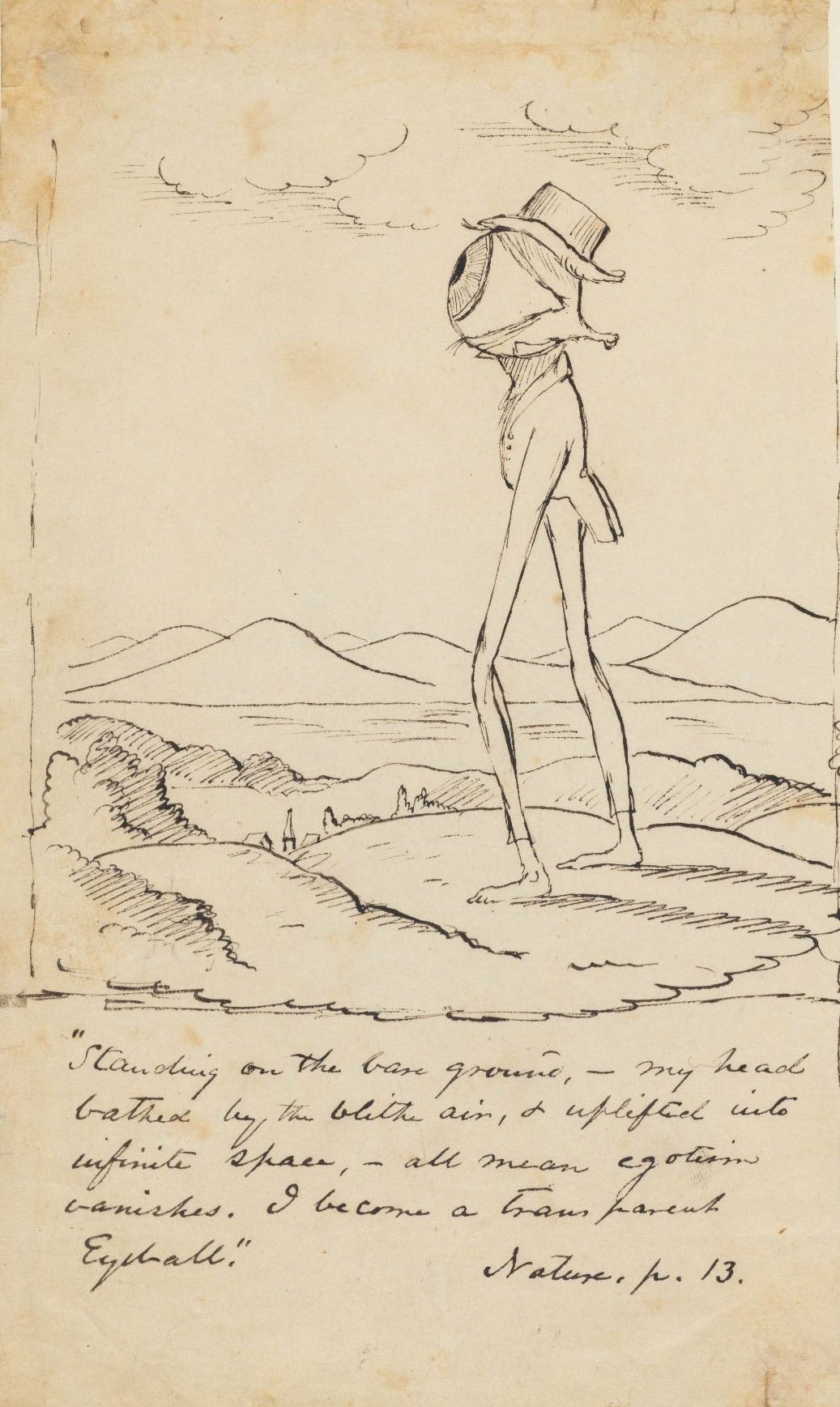
At this very moment, an unthinkable variety of events are occurring. Over a sunlit harbor, a bird is plunging from the sky to pluck some little fish from what would’ve been the rest of its life. Dust motes across all 195 countries are careening atop unseen gusts of air. And against all reason, I’m turning this newsletter into a full-time, paid-subscriptions ordeal, now titled: Here to Disappear.
Through Here to Disappear, I intend to publish narrative journalism about the resurgent study of consciousness. I intend to patrol the frontiers of our study of the mind, chronicling the strange zones of miraculous happenings across scientific laboratories, practice communities, and technological innovations. This is my idea of a good time.
Do not be alarmed by occasional forays into political economy, because economies are always in the business of producing minds. I am interested in varieties of the question: What is going on here, and what shall we do about it?
…
I’ve spent most of the last 11 years producing media about consciousness studies in one form or another.
For a while, I had a tiny blog. It was rather embarrassing, but thankfully, no one read it. At least, not at first. Eventually, it did well enough that it gave rise to a podcast where I interviewed philosophers, economists, meditators, and the like. I continued writing. It started going well, and I joined Vox as a fellow at Future Perfect. There, I discovered there’s quite a large general audience interested in journalism about consciousness that neither preaches awakening nor displays a startling lack of curiosity about the plasticity, depth, and experiential range that human minds are, given the right circumstances and stimuli, capable of.
That went well enough that I stayed on as a staff writer for a few years afterwards. I spent half my time covering consciousness science, meditation, and psychedelics. The other half went towards writing about economics: as big as post-scarcity and as small as unemployment insurance reform.
But eventually, as you might expect of a journalist pushing 3,000+ word features about DMT and “jubilantly realizing the inherent emptiness of all phenomena,” at Vox of all places, I got caught in a round of layoffs. Since then, I’ve worked freelance, publishing in magazines like Asterisk and Aeon (forthcoming), plus the occasional post here.
Most of my time has gone towards creating a five-part podcast series about transformative meditation experiences. It’s called Pivot Points, and it’s supported by the Waking Up meditation app, which readers of this newsletter might recognize as Sam Harris’ outfit. It comes out in a few weeks, and the trailer is already up:
If you’re already subscribed to this newsletter, you’ll receive an email when the series is published. But you can also follow it on Apple Podcasts right now, which will auto-download the series when the time comes, and help me curry favor with the algorithmic gods.
Anyway. What I’ve learned is that the problem with trying to live as a full-time freelancer who sells writing and podcasts to other platforms is that it’s an insane thing to do. The economics are completely unreasonable. I would soon be selling plasma. Perhaps a digit, or eventually, a limb. This may have something to do with the fact that I am a slow writer who likes to do a somewhat unreasonable heap of research. In fact, the slower I go, the better my writing gets.
And look, I wasn’t kidding before when I said an unthinkable variety of events are occurring. Not just birds and dust motes, but in the world of consciousness studies. A few decades ago, no respectable scientist would admit, at least in public, that they were interested in studying consciousness.
Now, foundations are putting real money into the science of ‘awakening,’ setting up all sorts of experimental probes into the deepest and allegedly most desirable transformations of consciousness available to the human species. Also, it still doesn’t seem that anyone can really tell you what awakening means.
A Harvard neuroscience lab is churning out the most interesting research on advanced meditation in the history of science. But you might not know this, because, well, here’s the title of their most recent paper: Endogenous suspension of phenomenal consciousness during extended cessation: Regional homogeneity analysis of multi-participant 7T fMRI of an advanced meditative endpoint. This is not the kind of English that, in general, people care to read.
A community of 300+ people is using what is arguably the world’s most powerful psychedelic, 5-MeO-DMT, to accelerate their meditation practice into the promised lands of “Radiant Great Bliss.” I join them on Zoom calls every now and then, and suspect there is, indeed, something peculiarly interesting, instructive, and fascinating going on there.
Michael Pollan broke the seal on mass-market writing about consciousness, and he seemed pretty confused. At least until he sat in a cave for three days, but then his book ended (a somewhat distraught Here to Disappear book review is in the works).
Panpsychism is a respectable worldview again, which means we have philosophy professors going on YouTube to debate whether reality is made of consciousness.
Neurotechnologies are piling up in the development pipeline. San Francisco is once again doing that thing where they concoct an extremely strange blend of spiritual practices and technological futurism.
What I’m saying is that it’s a delicious time to be a human being curious about the phenomenon we’ve taken to calling consciousness. All along the frontiers are strange zones of miraculous happenings. I’m giddy and terrified. Mostly, I’m transfixed. So I’ll patrol these frontiers in the same way that Thoreau surveyed the land of Concord, drawing maps of wild territory. I’ll drift through the science labs and practice communities in the same way that Annie Dillard went out roaming her backyard at Tinker Creek looking for God.
And rather than pitching various magazines until I go numb & broke, I think shifting my work’s center of gravity to a newsletter offering paid subscriptions in the spirit of patronage will, or at least could, support the best possible version of this writing.
A FEW THINGS YOU CAN EXPECT FROM HERE TO DISAPPEAR
Deeply researched, slowly published essays. I admire writers who lug around an inexhaustible sack of opinions from which they manifest a new article each week. I am not one of them. For me, essays are excuses to do research, travel to some remote corner of the globe in pursuit of seeing something other than pixels, interview actual humans, and arrange a series of words that finds some sort of sense, meaning, and delight in the whole mess. This takes me a while. I will take it, because I’d only like to publish essays that might be worth your time.
Besides, do you really want another four emails in your inbox every month? Do you really need more stuffing for that mind of yours? I reach into my skull and find some sort of empty space. This is, at best, what I will attempt to share with you. For I have grown peculiarly interested in the composition of this empty space, this material of spacious awareness that remains even when all of the stuffing has been set aside.Reportage about real happenings along the frontiers of consciousness studies. I care about writing. It can mesmerize. It can stir the great secret trunks of sentiment hidden beneath all our excuses. It can create moments in which we drop everything and are left naked, clutching nothing but our relationship with eternity. I look up to the lineage of journalists whose work carries various pretentious labels like “literary journalism” or “creative nonfiction.”
But I am not a novelist at heart. I am not interested in the craft of writing irrespective of its subject. Not in public, anyway. I would like you to come away from my essays having learned something about the people, projects, or ideas driving forward our study of the mind.Mostly, I write essays. But sometimes I wander off into other forms of media. I might interview meditators about their transformative experiences and produce a five-part podcast series about it. Perhaps another season is in order? I have some ideas. A few years ago, I built an economic policy database. Something like that could happen again. Who knows?
You will learn of my confusion. Susan Sontag has this haughty little quote from her journal: “I’m only interested in people engaged in a project of self-transformation.” As a general statement, I can’t think of a greater failure of curiosity. But it was in her journal, so give her a break. That said, I do think that creating substantive journalism about consciousness benefits from having the writer directly interested in the workings of their own mind, and engaged with their own transformative practices. Consciousness journalism is best when it comes from inside.
I’ve been meditating for about 12 years now, and experimenting with psychedelics for about as long. I’m not an evangelist of either, but I do suspect there’s something extremely mysterious and interesting buried deep in the layers of conscious experience. It’s a strange thing — atmosphere? — to experience directly. I am learning not to take mystery to mean an impenetrable phenomenon. Rather, it’s more like the beginning of inquiry. So you should know that my angle on all of this is not “awakening” or “healing” or even “well-being.” I’m tracking the faint glimmer of mystery that’s always receding into experience, like water being sucked back into the pores of a just-unclenched sponge. Consciousness offers direct experience of the mystery at hand, but only if you learn how to see. When I say that I’m writing narrative journalism about consciousness studies, what I mean is that I’m indexing various derangements of the senses to obtain the unknown. I’m tracking creative efforts in learning how to see the mystery that is always hidden in plain sight.
If all goes well, I will, at various times, stray from each of these dictums.
OKAY I GET THE JOURNALISM OF CONSCIOUSNESS THING BUT ECONOMICS?
When I was traveling around India in my early 20s and doing the meditation circuit, we’d commonly recite various chants and vows dedicating our time meditating to the benefit of all sentient beings. This was a sweet thing to do. But after a while, I got the sense that if I really wanted to help other sentient beings, it would do more good to work on something like reducing poverty than just going on another meditation retreat. When I consider what it means to really embody the contemplative ethic, at least for me personally, I think something like Barbara Ehrenreich’s Nickel and Dimed, a narrative account of what it was like to be a low-wage worker in the late ’90s, does more good than yet another dharma book or something.
If you go back to the classical political economists, Adam Smith himself wrote that “the understandings of the greater part of men are necessarily formed by their ordinary employments.” He worried that the division of labor, left unchecked, could make workers “as stupid and ignorant as it is possible for a human creature to become. The torpor of his mind renders him, not only incapable of relishing or bearing a part in any rational conversation, but of conceiving any generous, noble, or tender sentiment.”
Maybe that was a bit much. Maybe not. But economies are always in the business of producing minds. The study of consciousness is, necessarily, the study of socioeconomic structure. And concern for the consciousness of others entails more than just meditation and wishing others well and eighteen different kinds of therapy.
In 2021, we temporarily expanded the Child Tax Credit, cutting child poverty by ~40 percent. Democrats failed to unite around making the expansion permanent, and five million kids fell back into poverty. In my view, winning that policy battle would’ve done more for the aggregated condition of human consciousness than getting the same number of humans to do a meditation retreat, or recite mantras, or do IFS sessions, or pierce their veils of contracted selfhood, or whatever other experience spiritual folks, in their more lamentable moments, like to prescribe as the panacea for all social ailments.
German sociologist Hartmut Rosa, after examining the troubling mental texture of what it feels like to be a human living through modernity, finds that “sweeping economic, political, and welfare-state reforms thus appear to be an indispensable prerequisite for…a genuine reorientation of our individual and collective way of life.” Well, by many accounts, we’re living in exactly the kind of chaotic historical moment where the window for these kinds of changes is yanked open. I do not personally care for making sweeping claims about how we might reorient our collective way of life. I’m just some guy. But I am drawn to the way that narrative journalism can foreground, or maybe even forecast, the phenomenological stakes of deep policy change.
I do not think that we are on the AI-driven cusp of jobless, leisurely lives for all. There is always going to be work to be done, in every sense. But I like to imagine we can continue moving in the direction of economist Henry George’s vision of even “the man with the muck-rake drinking in the glory of the stars.”
WHY YOU MIGHT CONSIDER BECOMING A PAID SUBSCRIBER
You should become a paid subscriber if you’d like to participate in the ancient and honorable tradition of patronage, supporting work you would like to see more of in the world.
I’ve already described HtD’s (will this be a thing? This mildly grotesque acronym? I’m not sure) peculiar kind of work. But why support it, aside from the kicks of adding “patron of the arts” to your biography?
There is no major media publication dedicated to sending talented and thoughtful writers to cover matters of consciousness with a contemplative slant. You can find stray pieces scattered around, like an ayahuasca trip report in n+1, or a look at the business of jhana meditation in The Atlantic. But generally, these reporters and writers are not themselves contemplative practitioners. This means you get the kind of outsider’s view that can expose interesting sociological dynamics, while completely missing the juicy center, the question of what a sustained engagement with these practices and substances and technologies might actually unveil, or not, about the immediate mystery of consciousness unfolding in your experience of the world.
I am not a major media publication. But I can jump into this void. And should the money flow, I have a list of writers I’d love to commission into this void with me. I also have a list of editors I’d love to rope into sharpening this work. There is no end to my lists. You are probably on one of them. There’s a lot of work to do.
I should say up front, I am not ‘building a community.’ You should not think of becoming a paid subscriber as a transaction that gets you a bunch of special treats. There will be occasional paywalled stuff. Like bonus material from whatever podcast series I’m working on; cleaned-up interview transcripts; maybe even missives on the nature of phenomena that are too embarrassing to send out indiscriminately. But my larger, reported works will remain free. The paywall will likely surround a more ‘behind the scenes’ situation.
So, again. You can remain a free subscriber, receive all my biggest pieces, and I will be grateful for your presence. Or, you can subscribe for $7 per month, the price of an almond croissant at my local bakery, or $70 per year, the price of a taco dinner for two, including margaritas. It’s better for both of us if you do the latter. Cheaper for you in the long-run, and more stable for me to enjoy something of a predictable income1.
If I receive enough support to work on this project full-time, that’s what I’ll do. This would bring me great pleasure.
…
The name, by the way, Here to Disappear, comes from poet Anne Waldman’s introduction to Jack Kerouac’s The Scripture of the Golden Eternity. She writes: “We’re here to disappear, therefore let’s be as vivid & generous as we can.” This is something of an ethics statement for this work. You are, of course, free to simply pluck vividness and generosity from the shelf of nice moral commitments. You do not need to practice remembering death in order to grow them. But I suspect there’s a sturdiness, maybe even a richness, that comes with growing them in this manner. An otherwise morbid preoccupation gives rise to something curiously vibrant.
I used to read, or kind of yell, Kerouac’s scripture out loud on drunk 3am nights while writing short stories at G’s apartment after dinner shifts at our restaurant. Every now and then, one of us would stop, grab the little book, and yell random passages to no one in particular: “EINSTEIN MEASURED THAT THIS PRESENT UNIVERSE IS AN EXPANDING BUBBLE, AND YOU KNOW WHAT THAT MEANS.” Kerouac was nuts. But the Golden Eternity pried something open, a kind of howling tube in my gut of which this newsletter is like an echo: “Thou’rt a numberless mass of sun-motes: each mote a shrine.” You are here to disappear.
I'm an enormous fan of your writing, Oshan, and find myself thinking of points you've made on a daily basis. So excited for this newsletter and for your upcoming podcast series!
🦾🔮🪷