It remains unclear to us whether death is really any sort of ending. Probably, I’d wager. But how much stock would you place in a beetle’s metaphysics? In the Grand Scheme, I’m no better positioned than the beetle. Death could be an event horizon that shuts out the light our limited faculties require to see any further. In any case, Annie Dillard, the Pulitzer-prize winning lunatic of a writer who often wrote about God and muskrats and weasels, died at home on Tuesday, September 15th. She was 81. I hope she felt that she had done her work.
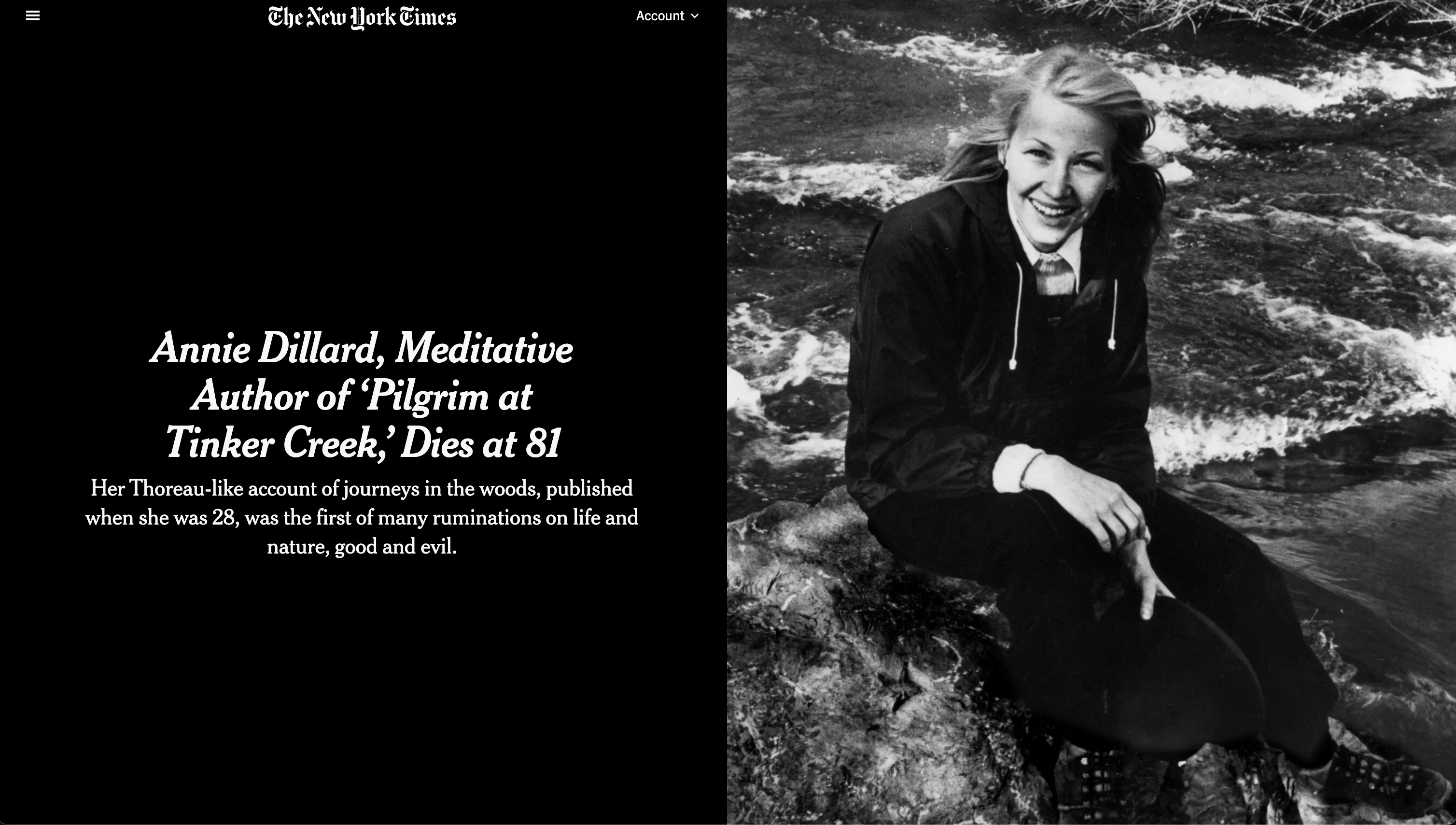
At 28, she published Pilgrim at Tinker Creek, which won her that Pulitzer in 1975. Mostly, the result was distraction. She was a theologian. Her business was always with the contradictory emanations of divinity. So in full flight from her success, she packed up and moved to a remote island in Puget Sound near the Western Canadian border. The idea, in her words, was “to turn from literary and commercial success and to rededicate myself to art and to God.”
The result, two years later, was a completely bizarre little book, Holy the Firm. It opens with one of many miracles she managed to document involving moths. She tells of a summer spent camping in Virginia’s Blue Ridge mountains. She read every night by candlelight, moths massed around her head. Usually, when the moths flew into the flame, they’d only burn for a second before jerking away. But the damage had been done. Their heated wings had been seared soft, and as the darting moths flew wildly from the flame, their melted wings fused to whatever first thing they touched. Pans, spoons, book jackets, etc.
This particular moth had a slightly different fate. “A golden female moth, a biggish one with a two-inch wingspan, flapped into the fire, dropped her abdomen into the wet wax, stuck, flamed, frazzled, and fried in a second.” Her wings flared and then vanished. Her legs “clawed, curled, blackened, and ceased, disappearing utterly.” When the show was over, Dillard wondered: “Had she been new, or old? Had she mated and laid her eggs, had she done her work?”
Dillard was possessed by the question of how creatures may learn to do their work. Bugs and animals display a singularity of purpose that she seemed jealous of. One time, she locked eyes with a weasel in the middle of suburbia and took home some wisdom.
“I don’t think I can learn from a wild animal how to live in particular--shall I suck warm blood, hold my tail high, walk with my footprints precisely over the prints of my hands?--but I might learn something of mindlessness, something of the purity of living in the physical sense and the dignity of living without bias or motive. The weasel lives in necessity and we live in choice, hating necessity and dying at the last ignobly in its talons. I would like to live as I should, as the weasel lives as he should. And I suspect that for me the way is like the weasel’s: open to time and death painlessly, noticing everything, remembering nothing, choosing the given with a fierce and pointed will.”
But the weasel’s way of living in pure necessity does not translate all that simply to a human life. I don’t consider it much of an affront to weasels to say that humans are tangled up in a more complex affair. Dillard’s weasel-like manner was once described as a “demented singularity of purpose.” Based on what she makes of the weasel, I think she would embrace this.
“We can live any way we want. People take vows of poverty, chastity, and obedience--even of silence--by choice. The thing is to stalk your calling in a certain skilled and supple way, to locate the most tender and live spot and plug into that pulse. This is yielding, not fighting. A weasel doesn’t ‘attack’ anything; a weasel lives as he’s meant to, yielding at every moment to the perfect freedom of single necessity.
I think it would be well, and proper, and obedient, and pure, to grasp your one necessity and not let it go, to dangle from it limp wherever it takes you. Then even death, where you’re going no matter how you live, cannot you part. Seize it and let it seize you up aloft even, till your eyes burn out and drop; let your musky flesh fall off in shreds, and let your very bones unhinge and scatter, loosened over fields, over fields and woods, lightly, thoughtless, from any height at all, from as high as eagles.”
I imagine myself attending Dillard’s funeral. Maybe if she has an open-casket, I could stand beside her still body and wonder, just as she did of the moth: Had she done her work?
…
Like many others, reading Annie Dillard did something irreversible to me. It set a slow and grinding process in motion. At first it was a thorn wedged between the cracks in my mind. It sat there for years, only registering a slight pinch in very particular movements, ones I seldom made. Sometimes it happened in the sea of bodies at a frat party, when I stood aloft on the risers and looked out at the creatures there gathered.
“What do we ever know that is higher than that power which, from time to time, seizes our lives, and reveals us startlingly to ourselves as creatures set down here bewildered? Why does death catch us by surprise, and why love? We still and always want waking. We should amass half dressed in long lines like tribesmen and shake gourds at each other, to wake up; instead we watch television and miss the show.”
I knew I was missing the show, but I couldn’t find any gourds. Then I read Pilgrim at some point in my early 20s and it was like a large mallet positioned itself straight above the exposed thorn’s face and cracked down, driving it so deep that something split open. Up to that point, I’d been restless. I had a long list of things I knew I didn’t want to do, ways I knew I didn’t want to live. But I had no better ideas. There’s a Sanskrit expression and meditation practice, neti neti, which translates as something like “not this, not that.” The idea is that you can open your experience to the essential nature of all things by way of negation. Choose anything that appears in your experience: The computer screen, the feeling of your lips against the cool air, a weasel, if you happen to see one. Every moment that you notice something arising in your experience, you say: This is not the essence of all things. Not this.
I gather that eventually, when there’s nothing left, something is supposed to happen. But through my first quarter of a century living, negation had not proved a decent way to live. I was adrift. I rejected any path I could find. I wasn’t interested in joining a monastery, or becoming a data scientist. I was sick of meditators and their riddles. I was bored of writers and uninterested in their stories. I was tired of philosophers and their tedious, hopeless fantasies that some arrangement of concepts will finally straighten out this business of living. Again, I was in my 20s. But then I read Pilgrim.
That book gave me a taste of what it felt like to yield completely to the single necessity of my life. It took me by the shoulders and pointed me towards a way of seeing the world that discloses the terrible and beautiful incandescent mystery inside of which we all one day, if we’re lucky, wake up. It’s well known among artists that, as per Mary Oliver, “The most regretful people on earth are those who felt the call to creative work, who felt their own creative power restive and uprising, and gave it neither power nor time.” I wanted to yield, to give my power and time, but didn’t know how. What do I do with it? Pilgrim shook the gourd in my face and said: This. And the entire humming civilization of 35 trillion cells lumped into the shape of my body sang back in a sort of chorus, unreservedly: Yes. This.
…
The ordeal with the candle-lit moth at the campsite did not end after her wings, legs, and head had burnt into oblivion. Her pale carcass remained, emptied of flesh and lodged upright in the pooled wax.
And then this moth-essence, this spectacular skeleton, began to act as a wick. She kept burning. The wax rose in the moth’s body from her soaking abdomen to her thorax to the jagged hole where her head should be, and widened into flame, a saffron-yellow flame that robed her to the ground like any immolating monk. That candle had two wicks, two flames of identical height, side by side. The moth’s head was fire. She burned for two hours, until I blew her out.
She burned for two hours without changing, without bending or leaning—only glowing within, like a building fire glimpsed through silhouetted walls, like a hollow saint, like a flame-faced virgin gone to God, while I read by her light, kindled, while Rimbaud in Paris burnt out his brains in a thousand poems, while night pooled wetly at my feet.”
I still have no clue what’s going on here, generally speaking. I’ve let go of the idea that there’s some sort of tolerable explanation for this clumsy business of reproducing and dying by the billions. What would it matter, anyway? Dillard asks: “Say you have seen an ordinary bit of what is real, the infinite fabric of time that eternity shoots through, and time’s soft-skinned people working and dying under slowly shifting stars. Then what?”
I’m dazzled and sickened by this mystery without end. But I’m learning that recoiling is always a losing strategy. I yield, and in yielding, to my surprise, there’s action. If I concentrate, I can see the mystery’s jugular vein bulging from anywhere I look. And rather than grasping at it, I just let go, and in that surrender I’m shocked as I witness my teeth clamping down, all my limbs working in unison as I taste the perfect freedom of single necessity. Dillard’s body, transmuted like the moth from flesh to light, burns even now after death. She threw everything she had into the candle. The soft bits burst and were gone in an instant. But now her empty vessel holds the flame aloft, casting a small sphere of light into the infinite darkness.
Thank you, Annie.
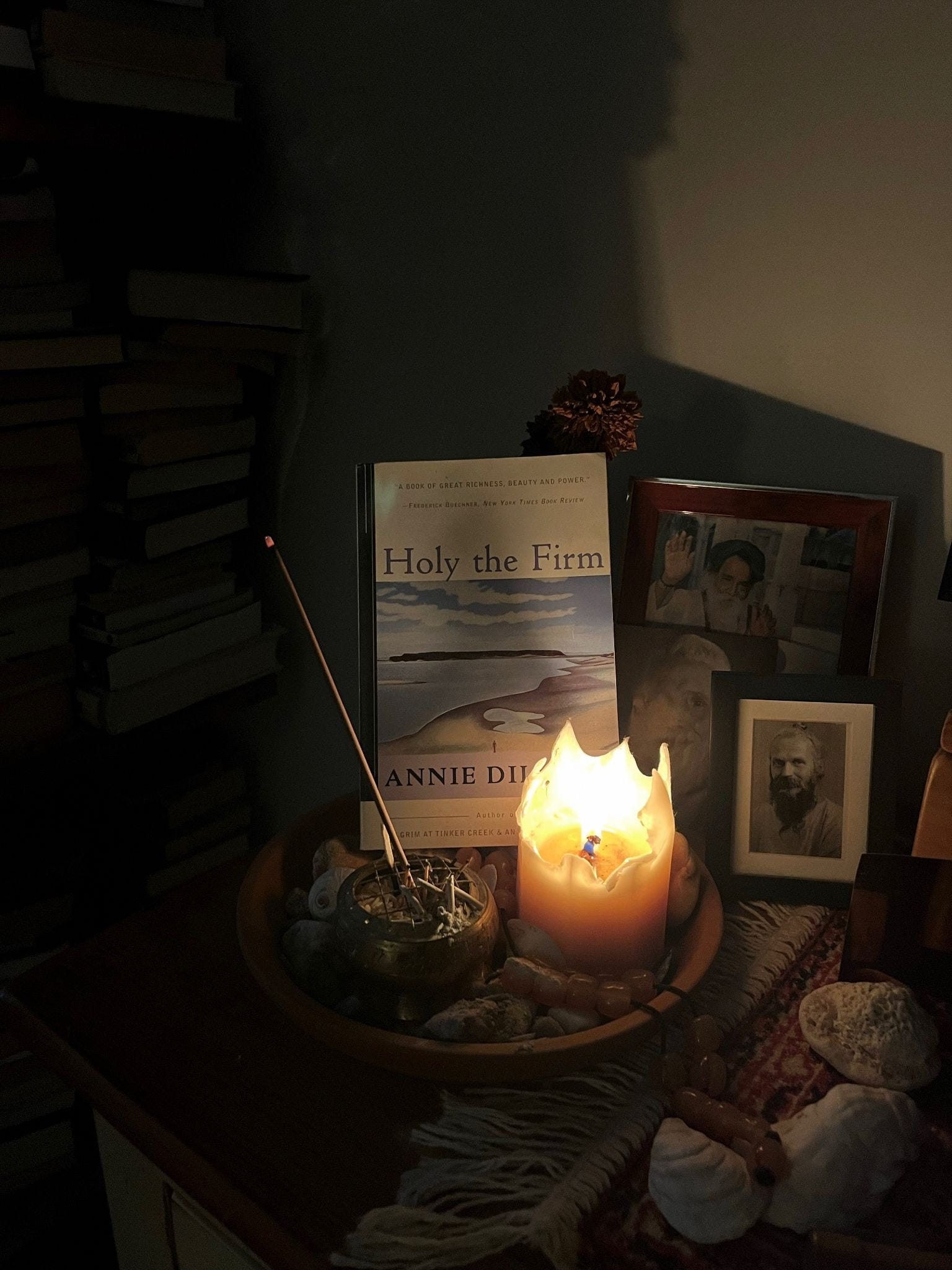
Good stuff, I didn't know of Annie Dillard or any of what you shared of your experience and the moth burning as the wick linger for sure, as well as neti neti. All good stuff for pondering on a 5+ hour drive back to the Northern Border. Great to see Ganananda and some incense burning in the pic too!
Lovely, and startling, Oshan. I have just been reading Dillard’s ‘The Writing Life’ on your recommendation - I think via your website? - at the same time as a book called ‘Wintering’ (Katherine May). All my reading - and listening, and practising - on work has led me a deep interest in rest. Rest in Peace, Annie.